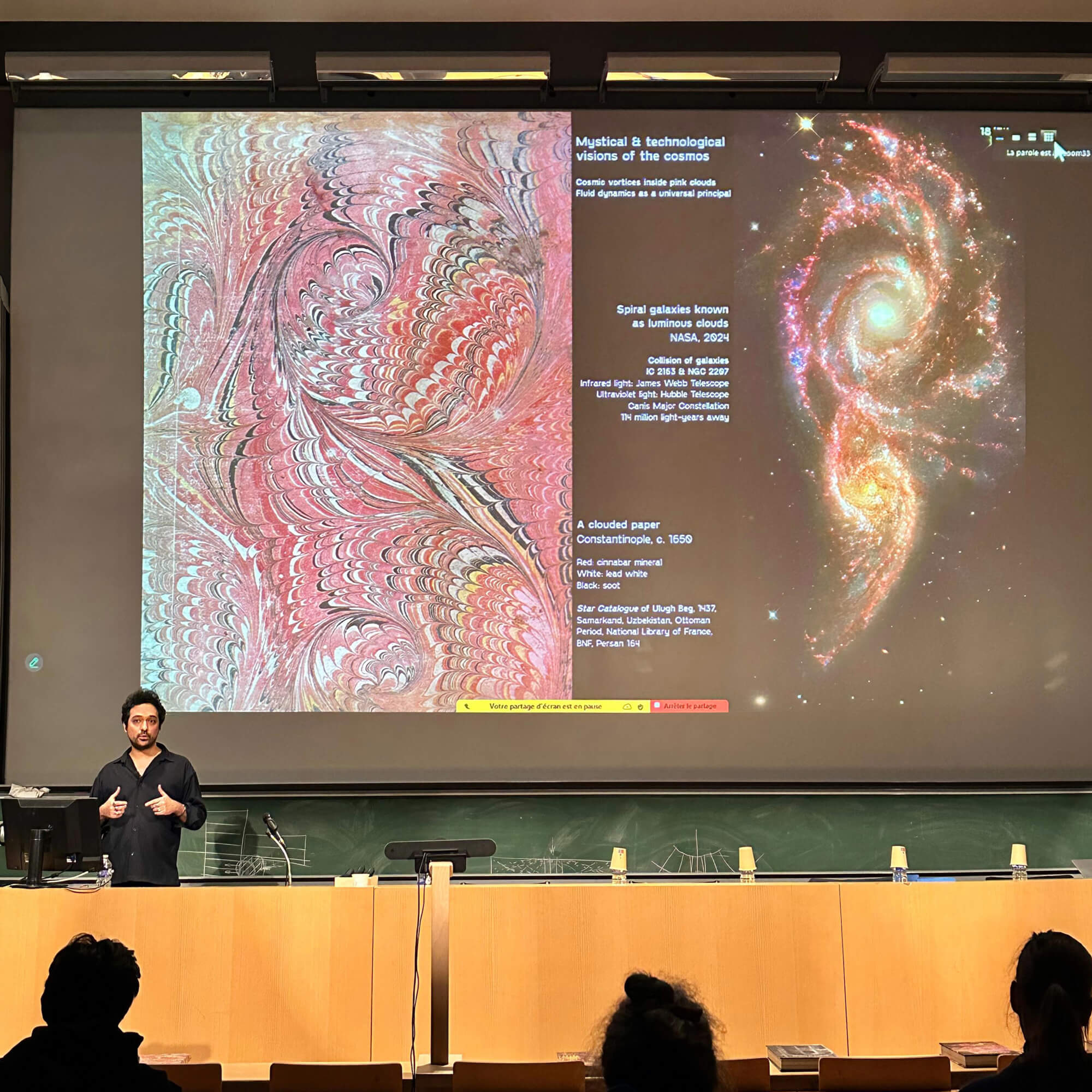
VIEW :[ FULL SCREEN ]LANGUAGE :[ EN ][ EN ][ FR ][ TR ]Listen to the universe[ BACK ][ PLAY ]Jupiter's Radio Emission - University of Florida, NASA, Radio JOVE[ NEXT ]List of soundsJupiter's Radio Emission - University of Florida, NASA, Radio JOVEGanymede (Jupiter's Moon) - Juno spacecraftSouthern Ring Nebula - James Webb Space Telescope (Mid-Infrared)Southern Ring Nebula - James Webb Space TelescopeExoplanet WASP-96b - James Webb Space TelescopeA black hole in the Perseus galaxy cluster - Chandra X-ray ObservatorySpiralling electrons in Earth's Atmosphere - NASAStar KIC12268220C - Kepler Space TelescopeSaturn radio emissions - Cassini spacecraftSince you arrived on this page:0 stars have been born across the observable universe.You have traveled 0 kilometers in an orbit around the black hole Sagittarius A* at the center of the Milky Way.0 photons from distant galaxies have reached your body.Live TelemetryLast updated --.Solar wind velocity:--km/sThe Breath of the SunCosmic ray intensity:--counts/minThe galaxy reaching Earth in a rain of particlesDeep Space Climate Observatory,NASA,National Oceanic and Atmospheric Administration,Neutron Monitor Database,Oulu Cosmic Ray Station[ CLOSE ]My PhD defense, in the background, two representations of cosmic clouds, one artistic, the other technological, ENSA Paris-Belleville, Paris, 10 November 2025.I am a researcher in cosmotechnics based in Paris. My work draws equally from ancient myths and science fiction narratives. I examine how images we have produced throughout history, from miniatures to artificial neural networks, function as models of the universe. I investigate the role of images, as systems of knowledge, across cosmology and computation. Through analogy, reconstruction, and experimentation, I study images as interfaces that connect different epochs and scales. Within this cosmographic approach, pigments transform into pixels, and hundreds of universes emerge within a single atom. Across a history of information technologies that stretches from cuneiform writing to artificial intelligence, I trace structural parallels between premodern traditions and posthuman thought.
My doctoral dissertation,
Empire of Clouds: Codes, Colors and Cosmos,
completed in 2025, is the culmination of this approach. It proposes a new compass for understanding the evolution of civilizations, shifting the point of reference from the Italian Renaissance toward a largely forgotten Turkish Renaissance. By outlining an alternative genealogy of our algorithmic world, the project grounds its origins in the coded cosmologies of the medieval Silk Road. In this context, the cloud emerges not merely as a modern technology or metaphor, but as one of the oldest media of information. Today, clouds have returned as forces shaping societies, no longer in the form of myths, but as planetary technological infrastructures. Like our future obscured behind layers of mist, whose indeterminacy persists, the cloud has become both the form and the medium of our thoughts.
In my work, scientific inquiry and artistic creation evolve together. I develop experimental applications of new media, including machine learning, augmented reality, 3D scanning, and simulation. These investigations take the form of video essays, audiovisual installations, interactive online platforms, and innovative mobile applications. A large part of my work is situated within digital scenography and heritage mediation projects. In collaboration with UNESCO-supported foundations, startups, municipalities, and research laboratories, I have carried out projects in Carthage, Samarkand, Paris, and Seoul. Beyond cultural heritage, the vegetal world also occupies a central place in my digital experiments. Between 2022 and 2024, I led the project Spolia botanique, which explores the design of botanical extensions of urban space through augmented reality. Awarded the 'Innovative Digital Services' grant, the project was developed with the support of the French Ministry of Culture, in collaboration with the Castle of Chaumont-sur-Loire and the Paris-Belleville School of Architecture.
My training at the Paris-Malaquais School of Architecture (2016) enabled me to approach contemporary issues through a spatial and territorial perspective. Just as the first cities and the first systems of writing emerge simultaneously out of Mesopotamian clay, I consider architecture as a medium of information, and information as a fundamental building block of space. Within this framework, matter and pattern appear as two sides of the same mirror. Beyond my own research, I explore these questions together with a group of architecture students. Since 2019, I have co-led the master’s seminar
Cities in Mirror
at the Paris-Belleville School of Architecture with Cristiana Mazzoni. In this seminar, we examine the city as a text written through an architectural alphabet, specific to a given civilization, territory, and moment. Through a digital platform we developed, we decode the underlying structures of contemporary cities using experimental cartographies.
My early professional experiences took place in Japan, China, and South Korea, in the offices of leading architects such as Kazuyo Sejima, Kengo Kuma, Jean Son, and Wang Shu. In these contexts, I encountered not only different design methodologies, but also traditions that reorganize the relationship between humans and nature in fundamentally different ways. I observed that tradition is not merely something to be preserved, but a living resource, continuously reinterpreted through contemporary technologies to generate alternative futures. The relationships between nature and human, tradition and innovation, could be reconfigured beyond dominant Western models. These approaches were not structured around binary oppositions, but around cyclical, inclusive, and evolving dynamics. These experiences shaped the central idea of my thesis, which conceives civilization as a spiral.Following my architectural training in Europe and Asia, my attention turned to the Silk Road, the space where these cultural spheres intersect. The earliest forms of globalization and cosmopolitan organization emerged along this network. It was also a region where a mathematical vision of the world developed, where algorithmic models of the universe were conceived, and where instruments such as the astrolabe, sophisticated analog computers, were widely disseminated. According to certain traditions, these lands were the place where the “eyes of the world” were gathered and exchanged. Each of these perspectives embodied a distinct worldview. I studied these modes of perception, which organize the world in different ways, by tracing the circulation of illustrated manuscripts, myths, and technologies across territories and epochs. In doing so, I analyzed the cosmologies underlying these visions and the pictorial traditions through which they are expressed.Extending this trajectory from Beijing to Constantinople, I expanded my research into the Mediterranean basin, the second major trade network of the medieval world. I was invited as a researcher to the Villa Medici in Rome, the Monastery of San Giorgio Maggiore in Venice, and the French Palace in Istanbul. My work led me to the Vatican Apostolic Archive, the Topkapı Palace in Istanbul, and the Marciana Library in Venice. There, I examined the often overlooked interactions between Renaissance Europe, Byzantium, and the Turkish world, which are typically framed as oppositional. This research allowed me to outline the main contours of a non-Eurocentric history of civilizations. These findings form part of a broader effort to develop a non-anthropocentric understanding of cultural evolution and to approach technology from a cosmological perspective. For this work, I was awarded the Daniel Arasse Prize in 2020 by the French Academy and the French School of Rome.The experimental methods I employ in my design and research are grounded in non-linear and multi-layered modes of thought. Inspired by hacker culture, this approach questions established rules and institutional frameworks. Rather than adhering to predefined structures, I develop open-ended processes in which chance and error become productive forces. Ideas emerge through iterative dynamics rather than pre-planned systems. In an age where the complexity of technical systems exceeds human perception, metaphor and analogy are no longer merely poetic devices of the past, but fundamental tools of survival. This is not a story of grids, but of spirals. Not a story of order, but of turbulence. Cosmology is not simply one discipline among others, but a foundational condition of thought. This perspective allows us to rethink technology not as something opposed to nature, but as one of its forces. It calls for a redefinition of creativity, consciousness, intelligence, and life, extending these notions beyond the human to include vegetal, mineral, geological, and cosmological forms. In this sense, the universe appears as a mathematical order composed of enigmatic symbols, a cosmopolitan ecology of intelligence.